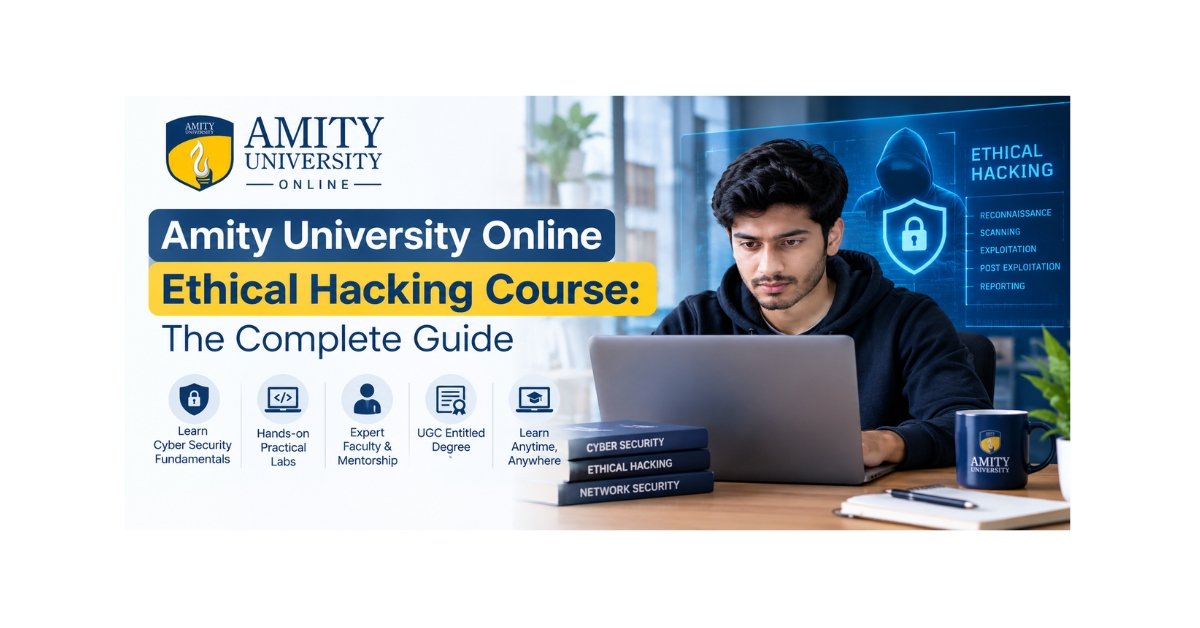
Amity University Online Ethical Hacking Course: Your Complete Guide for 2026
UAE’s spending on cybersecurity alone will shoot up until 2026, and one figure alone is enough to give you the answer as to why so many people have started looking for “ethical hacking course” through Google. Every search related to this course leads to Amity University Online. Here is an honest and thorough review of the course itself and of its suitability to help you decide about joining the course.
Why Ethical Hacking Has Become Such a Sought-After Skill
All organizations have information in form of customer data, finances, communications, among other sensitive information, that is held in some servers, that is being tried to be hacked by someone somewhere. The ethical hackers are the people who are employed to hack the system before anyone else, and thus make the system secure.
This is not something that is going away anytime soon because of legal accountability. In the last couple of years, there has been an increase in the number of regulatory frameworks such as GDPR and HIPAA that force companies to take responsibility of any data breaches. Thus, companies must hire someone to test their systems.
What Amity University Online Actually Offers
A Brief Look at the Institution
It is an established university in the realm of education, and their online branch has already made a name for themselves among students looking to gain a certified qualification that does not require any relocation from their current location. It is not a brand-new program that capitalizes on the hype surrounding cybersecurity at present.Get Free Counseling
Where Ethical Hacking Sits in the Curriculum
Point to be cleared at the beginning: ethical hacking training provided by Amity is generally not offered as an individual program in the form of weekend workshop. Ethical hacking is a part of some other package in most cases, which happens to be BCA with Specialization in Cloud and Security. Therefore, whenever one is looking for "Amity ethical hacking course," he or she should know that this course forms a part of the larger cybersecurity program.
This is an obvious strength of the structure. Learning penetration testing software without knowing how networks, servers, and operating systems interact is likely to result in individuals capable of running a test, yet unable to provide an explanation of its findings. This is exactly what Amity does.
As the names of the courses and specializations change from year to year, it is wise to find out about the actual course structure by looking at the admissions website of Amity, rather than depending on external sources only.
What the Coursework Covers
Foundational Groundwork
The first modules will be about the fundamentals of networking, operating systems design, and a brief introduction to the threat environment that organizations currently face. It may not be the exciting part of the course, but ignoring it is one of the reasons why many people have difficulty with the more challenging lessons.
Applied and Technical Modules
After the foundations have been set, then comes the time when the curriculum delves into the identification of vulnerabilities, malware behavior, and penetration testing methodologies, all of which are undertaken in the confines of virtual labs to avoid any kind of damage. The risk assessment methodology and incident response planning are also covered here, as much as the prevention of attacks as their response.
Skills You Should Reasonably Expect to Gain
By the end of the program, a student should be able to:
Identify network and system vulnerabilities before they're exploited
Operate common penetration testing tools with working knowledge of what they're actually doing
Understand how malware spreads and how to contain it
Apply basic encryption and cryptography principles
Build and manage a secure testing environment
Translate technical risk into language a non-technical manager can act on
The above-stated ability is frequently ignored, yet it often is that factor which makes the difference between promotion and being a technician for life.
Who This Course Actually Fits
People Switching Careers
Ethical hacking is one of those rare cases where skill is valued above experience in terms of education background. It doesn’t matter what degrees you have; what matters is if you can discover any weaknesses during a technical interview.
Recent Graduates
Students who have a general interest in computers and not specifically any knowledge in cybersecurity may find that this is a feasible course because it does not require long-term IT experience.
IT Professionals Looking to Specialize
If the individual is already working in networking or system administration, gaining knowledge and skills in ethical hacking would easily lead to better paying jobs.
Why Accreditation Actually Matters Here
That is where many inexpensive online programs lack credibility. Recording a few videos is all it takes to create an accredited certificate program. The thing that actually gives value to your program in the eyes of employers is actual accreditation, preferably international. Whenever looking at any cybersecurity program, including the one from Amity University, it is vital to see which accrediting agencies support the particular specialization within the program you are taking. This information is more valuable to employers than anything else on your resume.
How Amity Compares to Other Online Options
Versus Short-Form Platforms Like Udemy
Udemy and such platforms are affordable and versatile, but they really help to learn a certain technique. What they do not provide is formal accreditation by an academic institution or curriculum. In case you need an officially accredited certificate that will be recognized by the HR, then a university-based course might work better for you.Get Free Counseling
Versus Intensive Bootcamps
This cramming of knowledge into a relatively short and costly period works well for some and fails miserably for others. At Amity, the process takes place in a somewhat relaxed manner where enough time is provided for assimilation before progressing onto the next module.
Career Paths After Completion
Roles Worth Targeting
Typical placements for graduates include positions such as penetration tester, security operations center (SOC) analyst, vulnerability assessor, and cybersecurity consultant. In some cases, graduates will earn money from working as freelancers and participating in bug bounties through websites such as HackerOne and Bugcrowd.
Industries Actively Hiring
It is not confined to only IT companies anymore. In-house security teams exist in banks, hospitals, government departments, e-commerce sites, manufacturing companies etc., because compromising their systems can lead to dire legal and financial repercussions.
What to Realistically Expect on Pay
Salaries can vary widely from country to country, based on experience, and whether the person is working in-house or freelance. The one thing that remains constant is the fact that ethical hacking is a highly-paid career choice for entering the technology sector, and salary grows rapidly with proven skills and not necessarily years of experience.
Getting the Most Out of the Program
Practice inside a virtual lab rather than just watching lecture videos passively
Join active cybersecurity communities or forums to compare notes and troubleshoot with others
Set up a personal home lab if your hardware allows it; repetition matters more than theory here
Follow real-world breach reports, since threat techniques evolve faster than most textbooks can keep up
Don't rush past the networking fundamentals, they resurface constantly in advanced modules
Mistakes Students Commonly Make
One of the recurring mistakes that people make at the beginner level is rushing into using the complicated tools for hacking without knowing the systems these tools will operate on. One of the typical blunders made by beginners is the misconception that the achievement of the certificate marks the end of the process rather than just the beginning. Threats in cybersecurity emerge almost monthly.
Is It Actually Worth the Investment?
Certainly, but with one condition. That is the benefit you get by combining formal studies with hands-on experience outside the class. The problem with a certificate alone is that it often does not meet expectations no matter which institution awarded it. If you are thinking about getting a certificate in photography, be ready to spend your own time practicing besides attending classes.
Conclusion
It is true that the program will not be among the cheapest but neither will it be the shortest of two-week duration, but if you are looking for an accredited course, then you should know that the course is able to match up with other courses. Given the ever-increasing number of cybersecurity threats in most industries, the need for professional hackers can only increase. You should know that it is advisable that you cross-check the curriculum and accreditation of the course from Amity University.Get Free Counseling
Frequently Asked Questions
1. Do I need prior coding experience to enroll?
Not typically. Most programs start from foundational networking and systems concepts before introducing technical depth, so a basic comfort with computers is usually enough to begin.
2. How long does the program take to finish?
It depends on the specific track, since ethical hacking is often part of a larger degree structure. Timelines can range from several months for standalone modules to a couple of years for a full specialization.
3. Will this help me prepare for certifications like CEH?
The core concepts overlap substantially with industry certifications like CEH, giving you a head start, though dedicated exam preparation separately is still recommended.
4. Can this be completed alongside a full-time job?
Yes, that flexibility is one of the main reasons people choose the online format over campus-based alternatives.
5. Is ethical hacking actually legal?
Yes, provided you have explicit authorization to test the systems in question. That authorization is the entire legal distinction between ethical hacking and criminal intrusion.
6. Do employers take online university credentials seriously?
Increasingly so, particularly when the program carries verifiable accreditation and includes hands-on lab components rather than theory alone.
7. What trips up most students in this kind of program?
Consistency. The material builds sequentially, so falling behind on foundational modules tends to compound into real confusion later in the course.